
Blog Post
The Role of Mystery Shopping in Supporting Staff Accountability
📅January 22, 2026

Maintaining consistent service standards across teams, departments, and locations remains a major challenge for many organizations. Policies, procedures, and training programs clearly define what good service should look like, yet leaders often struggle to ensure those standards are applied consistently in day to day operations. Without reliable visibility into real customer interactions, accountability can easily become based on assumptions rather than facts.
Mystery shopping plays a critical role in addressing this challenge. By providing objective, real world observation of service delivery, mystery shopping helps organizations understand how staff actually perform when interacting with customers. Unlike internal reports or self assessments, mystery shopping reflects genuine customer experiences without bias. When used correctly, it becomes a powerful tool for supporting staff accountability in a fair and constructive way.
Why Accountability Is Difficult to Maintain
Many organizations invest heavily in defining service standards and training employees on expected behaviors. However, translating these standards into consistent performance is not always straightforward.
Common challenges include:
- Limited visibility into daily customer interactions
- Inconsistent application of service standards across locations
- Reliance on self reporting or managerial observation
- Difficulty addressing performance issues objectively
Managers cannot be present for every customer interaction, and employees may unintentionally drift away from expected behaviors over time. Without objective evidence, it becomes difficult to hold teams accountable in a way that feels fair and credible.
Mystery Shopping as an Objective Measure
Mystery shopping addresses these gaps by offering an independent and unbiased view of service delivery. Trained evaluators interact with staff as regular customers and assess performance against predefined criteria. Because employees are unaware of when an evaluation occurs, the results reflect normal behavior rather than performance influenced by observation.
Mystery shopping provides insight into:
- How consistently service standards are applied
- Whether policies and procedures are followed in practice
- How staff communicate with customers
- How confident and professional interactions feel
This objective perspective allows organizations to move beyond assumptions and base accountability on evidence.
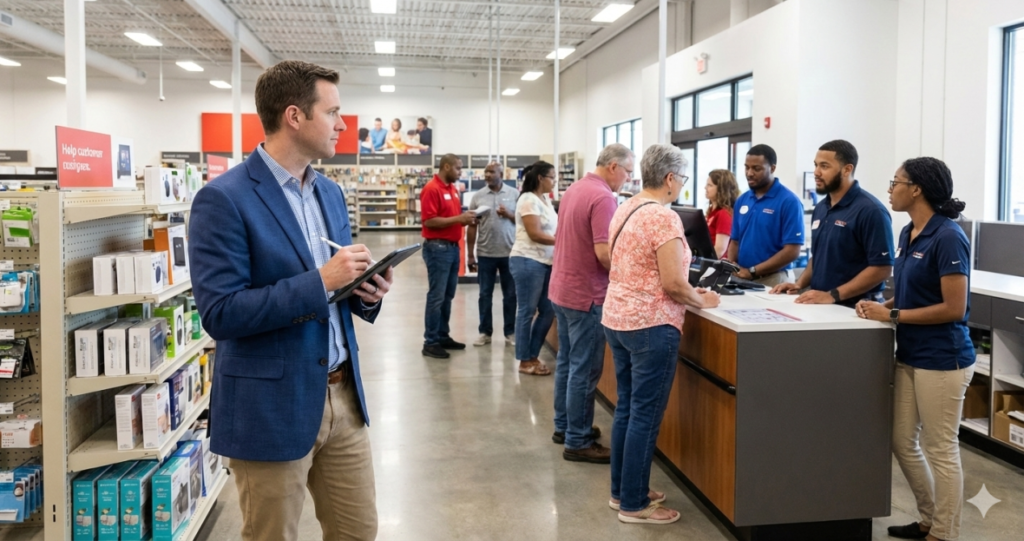
Shifting Accountability From Assumption to Evidence
One of the most important contributions of mystery shopping is the shift it creates in how accountability is managed. Instead of relying on anecdotal feedback or isolated complaints, leaders gain structured insight into performance across teams and locations.
This shift supports accountability by:
- Clarifying expectations through measurable behaviors
- Providing consistent criteria for evaluation
- Reducing subjectivity in performance discussions
- Creating transparency around service standards
When staff understand that performance is measured consistently and fairly, accountability becomes clearer and more accepted.
Supporting Managers With Reliable Insight
Managers play a central role in reinforcing service standards, yet they often lack reliable data to guide coaching conversations. Mystery shopping fills this gap by providing managers with concrete examples of what is working well and where improvement is needed.
Managers can use mystery shopping insights to:
- Identify coaching and training needs
- Address performance issues early
- Recognize and reinforce positive behaviors
- Compare performance across teams or locations
This evidence based approach helps managers move away from general feedback and toward specific, constructive guidance.
Encouraging Fair and Consistent Performance Management
When accountability is inconsistent, employees may perceive performance management as unfair. Mystery shopping helps create a level playing field by applying the same evaluation criteria across the organization.
Benefits include:
- Greater consistency in performance expectations
- Reduced bias in evaluations
- Clear benchmarks for acceptable service delivery
- Improved trust between staff and management
Because mystery shopping focuses on behaviors rather than personalities, it supports a more objective and respectful approach to accountability.
Using Mystery Shopping to Reinforce Training
Accountability is most effective when it is linked to development. Mystery shopping insights help organizations connect performance gaps directly to training initiatives, ensuring that accountability supports improvement rather than punishment.
Effective organizations use mystery shopping to:
- Reinforce standards through ongoing evaluation
- Measure improvement following training interventions
- Provide targeted coaching for specific behaviors
- Update training content based on real performance gaps
Creating a Culture of Ownership
When implemented thoughtfully, mystery shopping supports a culture of ownership rather than fear. Employees gain clarity on what is expected, how performance is measured, and how improvement is supported.
Key cultural benefits include:
- Increased awareness of service standards
- Stronger sense of personal responsibility
- Greater engagement with service quality goals
- Improved consistency across teams
Rather than being seen as a policing tool, mystery shopping becomes a shared reference point for quality and professionalism.
Best Practices for Using Mystery Shopping to Support Accountability
To be effective, mystery shopping must be positioned correctly within the organization. Poorly communicated programs can create resistance, while well designed programs encourage engagement.
Best practices include:
- Clearly communicating the purpose of mystery shopping
- Linking evaluations to coaching and development
- Sharing results transparently and constructively
- Recognizing strong performance as well as gaps
When staff understand that mystery shopping exists to support improvement and consistency, acceptance and impact increase.
Strengthening Accountability Through Insight
Maintaining service quality requires more than policies and training alone. It requires reliable insight into how standards are applied in real customer interactions. Mystery shopping provides this insight, helping organizations support staff accountability in a fair, objective, and constructive way.
By shifting accountability from assumption to evidence, mystery shopping empowers managers, clarifies expectations for employees, and strengthens service consistency across the organization. When used correctly, it becomes not just a measurement tool, but a foundation for trust, development, and sustained performance improvement.
Let's Talk
If you’re looking to improve performance, customer experience, or operational efficiency, we’re ready to help.
Phone
+965 22022095
info@halconsultant.com
Location
Kuwait City, Al Soor St, Al Tijariya Tower, Floor 24